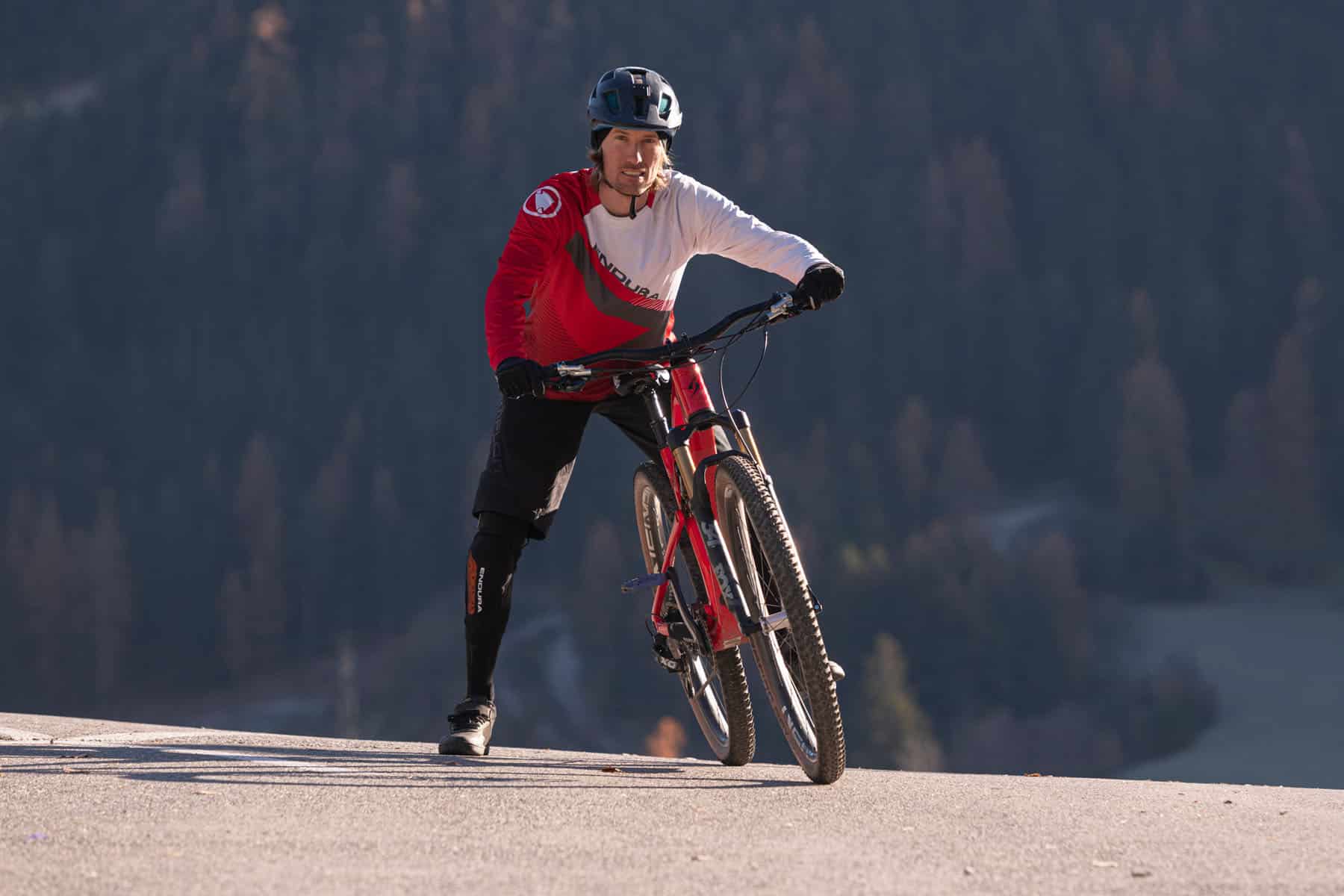
Curves, switchbacks and berms
This article is part of a riding technique series, which is intended to give participants in our riding technique courses a summary of relevant content to read. Of course, there is sure to be one or two good tips for everyone else as well.
Cornering is simultaneously one of the most elementary and complex chapters in mountain bike riding technique. On the one hand, it is a basic requirement that you get somewhere at all, and on the other hand, as you can see perfectly in racing, there is an almost infinite potential for optimization. Here we describe three basic principles. The steering technique, which is primarily used at slow speeds, and the lean and press techniques for fast turns. The choice of technique for fast turns then depends on the ground conditions and the type of curve. If slipping is virtually impossible, as in berms, we use the lean technique. However, if grip plays a crucial role, the press technique is the method of choice. In reality, however, they are often mixed forms, as curves on natural trails are always different and the characteristics can differ at the beginning and end of the same curve.
Steering technique – Steering the curve


Basically, there are several techniques for cornering. The steering technique, also known as curve steering, is mainly used at slower speeds. The most important elements are line of sight and balance. The line of sight must always be towards the exit of the curve. This is also known as steering vision. To practice steering, it is best to ride a figure-eight, which can be set up optimally with two cones or water bottles. At the beginning, pay attention to an optimal gear so that you can pedal well forwards and backwards. The figure-eight can be ridden sitting or standing. With the help of body rotation and looking towards the exit of the curve, the curve is initiated with a counter-steering movement to the outside. The body’s center of gravity shifts to the desired inside of the curve. The handlebars are guided by the outside hand. The rear brake can be used for more stability. If you observe the front and rear wheels closely, you will notice that the two wheels have different tracks. We can use this knowledge in a useful and advantageous way on the trail. Other exercises, such as slalom riding, cutting cones, circling squares or serpentines, are ideal for practicing steering technique. Variations in the terrain, such as gravel, meadow, forest floor or on an incline or descent, are ideal for gaining further movement experience.
Press technique on a mountain bike

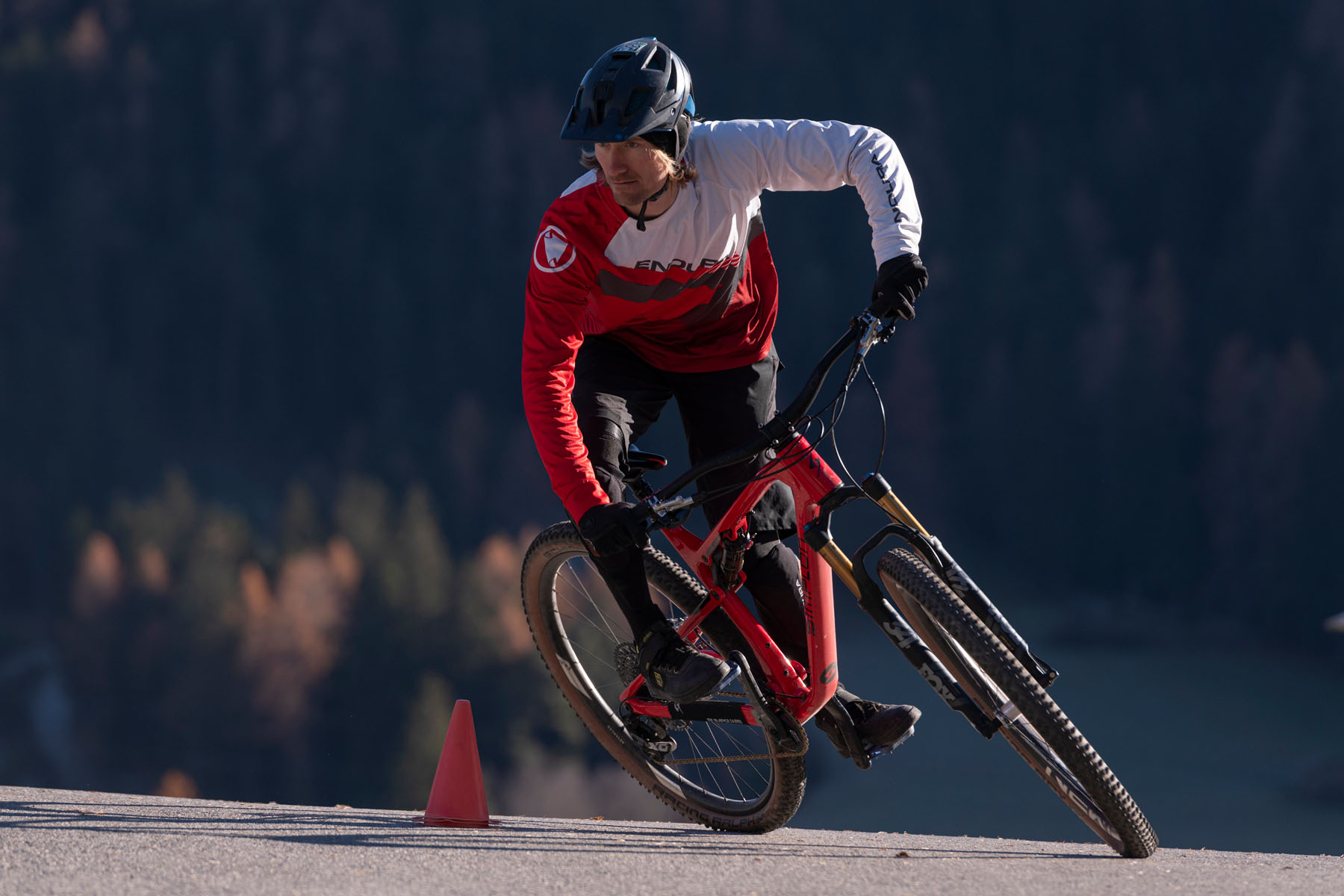


Especially on trails, but also on gravelly forest roads, there are numerous open curves that do not have a berm.edges, or rather walls. The risk of slipping is high and is a major fear factor for many. The ‘leaning’ technique is particularly suitable for these turns. Here, the bike is pressed under the body to the left or right, and the hips are rotated in the direction of the curve and shifted outwards. With the leaning technique, it is important to adjust your speed before entering the turn so that in the cYou no longer have to brake as much as possible. In trail behavior you brake, look towards the exit of the curve, release the brakes and start to lean the bike. The outer arm is angled and remains in the usual trail behavior position, but the inner arm is stretched more than in standard trail riding. The bike leans through the body rotation of the head, shoulders, hips, and the aforementioned outer elbow. It is pressed into the turn. Your belly button, like your head, should face towards the exit of the turn. For simplicity, the crank position can remain horizontal. If you want to generate even more grip so as not to slip away, the leg on the outside of the curve can be lowered. Never should the pedal on the inside of the curve be down, otherwise it could touch the ground and cause a fall. For many, the rotated, outward-facing hip is an unfamiliar position. This can e.g. be practiced perfectly with an exaggerated out-of-the-saddle sprint. In general, parking lots with different surfaces are great for setting up a turn using cones. It is important to always practice on both sides. Additionally, the elements of the leaning technique can be practiced individually. For example, focus mainly on your line of sight during the first few turns. For the next ones, pay special attention to your hips. Gradually, all parts are strung together. Nevertheless, it is important to always practice these techniques off-road as well. Simple flow trails or forest roads are great for training this. As with the steering technique, the turn should be initiated here with a counter-steering movement. This allows you to enter the turn more dynamically. For advanced riders, the timing of maximum pressure build-up on the tires is also added to carve around the turn as if on rails.
Typical mistakes

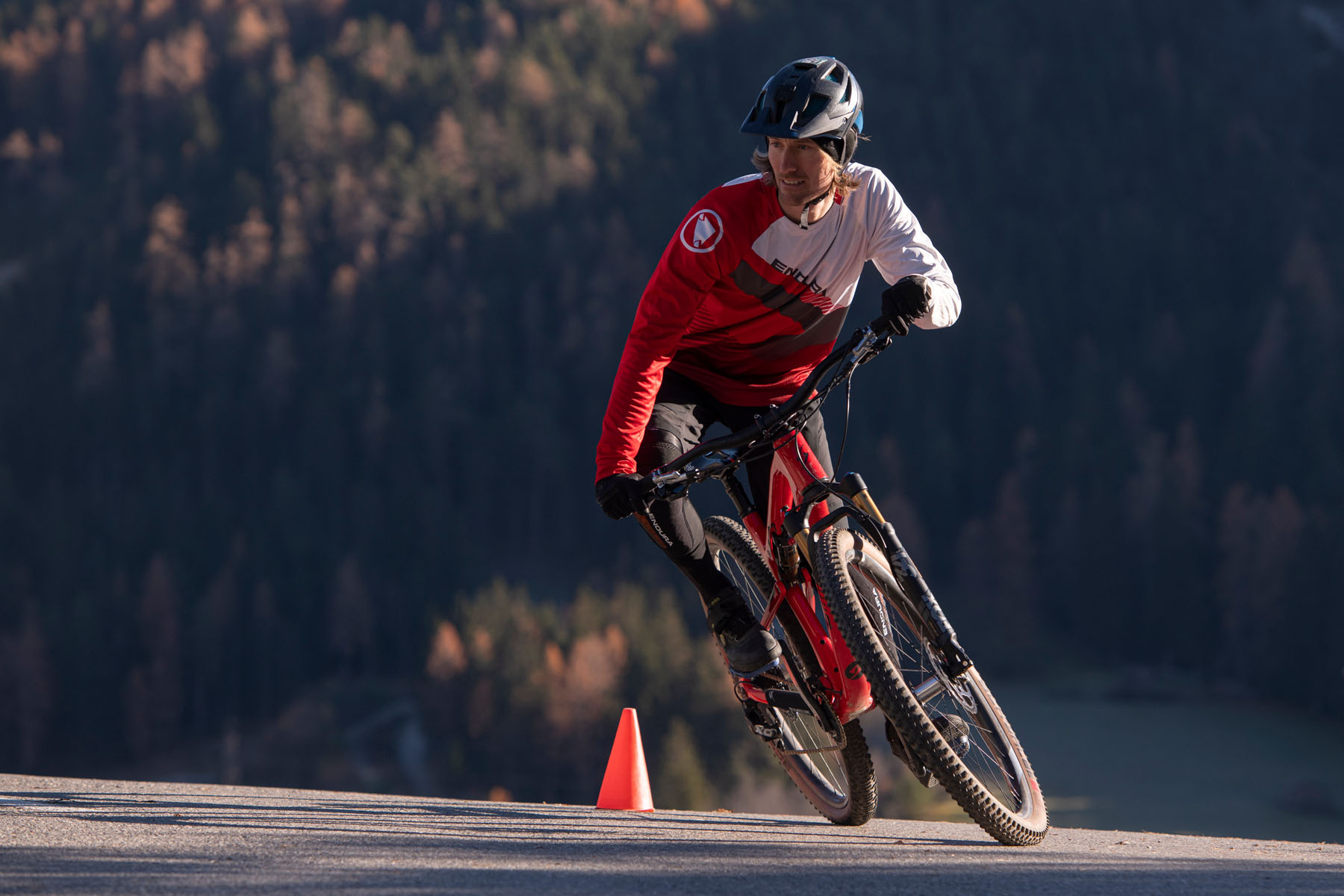

Leaning technique in steep turns
Berms are turns that have a banked edge. These are usually found on purpose-built trails. But also on natural paths you can use small counter-slopes or channels as berms. Since slipping away is very unlikely here and large centrifugal forces occur at appropriate speeds, the leaning technique is used for these curves. As the word suggests, it is possible to lean into this curve with your body and bike alike. The starting position is the trail behavior. With your gaze and body rotation, you lean into the turn. Through core tension and counteracting the forces, the body and bike form approximately a right angle to the ground. Due to the berm, the tire here runs more on the tread and less on the side lugs. The centrifugal force pushes the rider into the steep curve , slipping outwards is almost impossible. Therefore, the press technique would not offer any advantages here, and we use the leaning technique, which is better suited to counteracting the centrifugal forces.. Don’t forget, as mentioned at the beginning, this is a technique for fast curves and therefore only works at appropriate speeds which generate sufficient centrifugal force in the curve.