
Starting and dismounting off-road
This article is part of a riding technique series, which is intended to give participants in our riding technique courses a summary of relevant content to read. Of course, there is sure to be one or two good tips for everyone else as well.
For many, biking is not just a hobby, but a passion. Some tinker and tweak the perfect suspension setup, while others hop on their bikes and shred the most exciting trails. The pleasure cyclists among us enjoy the beneficial change from everyday life and delight in the nature and landscape. Children trick and motivate each other with newly learned jumps. Biking is a sport that almost anyone can easily do. Nevertheless, we at Flat Sucks have a few riding technique tips for you to ensure more safety and even more fun on the bike. This article is all about “Starting and Dismounting Off-Road.” What good is the best (e-)bike if you can’t get going in a steep section? And how do I dismount correctly in front of a difficult spot in the terrain without falling? You can find an explanation in this article.
Starting on a hill


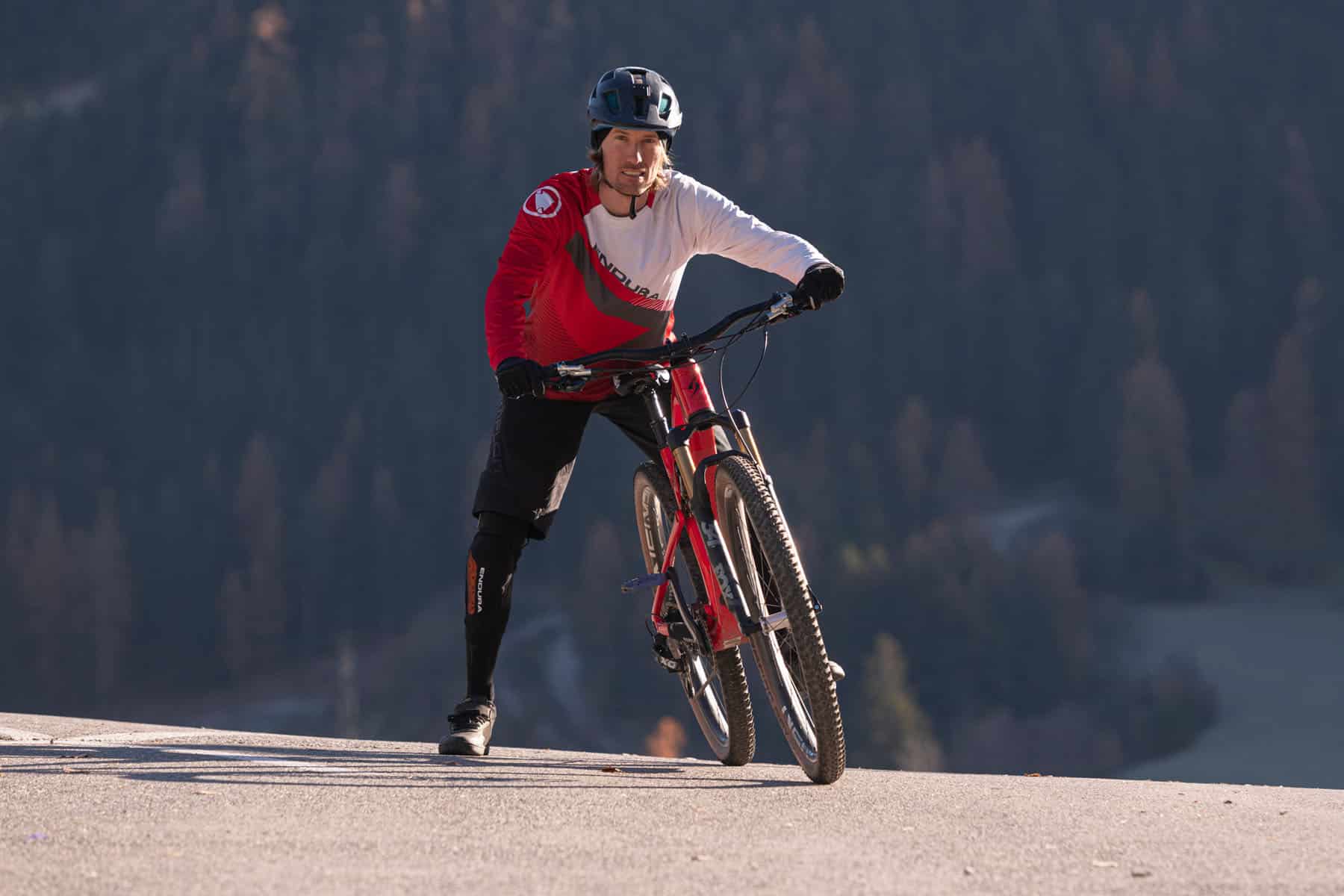
To make starting easier, a suitable, usually lighter, gear is needed. This should be set beforehand or, in an emergency, while standing. The bike is placed slightly diagonally and you stand on the uphill side of the terrain. It is especially important that both hands are on the handlebars and the brakes are always applied. This prevents the bike from rolling away when you get on. The leg closer to the bike is passed over the rear wheel or saddle. Make sure that you form a stable triangle with the front wheel, rear wheel, and the supporting leg. If the supporting leg is too close to the bike, you will easily fall over. While one leg is still the supporting leg, the second is unweighted and is on the pedal in the two o’clock position. A stone or root may be useful for pushing off with the supporting leg when starting. It is important to maintain saddle contact. To avoid the rear wheel spinning, the rear brake can be applied lightly. This is slowly released when starting. If it goes steeply uphill immediately, the crouched position must be adopted to prevent the front wheel from rising. The elbows are pulled down and the upper body goes deep. The buttocks also slide further forward on the saddle depending on the incline. The gaze is always directed forward.
Dismounting off-road


Emergency situations occasionally require a quick dismount from the bike. Therefore, it is important to continue to hold the brakes when stopping. If possible, it is advantageous to stand at an angle to the slope. Again, it is important to dismount on the uphill side. The upper, unweighted leg is placed down and again forms a stable triangle with the front and rear wheels. The second leg is lifted over the saddle or rear wheel. In very steep terrain, you generally dismount backwards. In extreme cases, you sit on the rear wheel. Under no circumstances should you go in front of the saddle when dismounting uphill in the terrain, as this can lead to unwanted rollovers. If you ask yourself why you should practice getting on and off, safety is the top priority here as well. If it is always and everywhere possible for a rider to get on and off safely, this eliminates the possible uncertainty in front of more difficult spots. With this skill, everyone has the necessary security to be able to dismount safely in emergency situations.
Carrying the bike
In order to reach even higher, further, and more beautiful, unique trails, the bike must also be shouldered again and again. Carrying the bike should also be practiced first. It is best to stand to the side of the bike and turn to face it. The crank is positioned with the pedal facing us downwards. Ideally, you now grab the bike at the suspension fork and at the lower end of the seat tube. By gripping firmly, swing the bike over your head and place it on your shoulders. It is practical to already have a well-filled backpack on your back. The bike can be well positioned and balanced on it and should not press directly on the shoulders or in the neck. The bike can also be held on one pedal. To make lifting the bike easier, the bike can also be placed on a small slope or stone. Again, grab the bike at the suspension fork and at the lower end of the seat tube. Now you can slip under the crank with your head and lift the bike onto your shoulders more easily.


